


Page 30 - ISLA_SLReport_Aug2020_double
P. 30
The Impact of the Covid-19 Pandemic       This report summarizes the changes in credit Consensus   in the creation of credit Consensus , with a focus upon
                                                                                                                                 2
        on the Global Financial Network           of different groups of financial counterparts as well as   the delivery of actionable information in the credit
                                                  their current credit distribution and any migration from   space. We also understood that there was another
        The impact of the Covid-19 crisis to the global financial   investment grade to high yield.      way of looking at the credit process and its outputs.
        network has accelerated the downward transition of                                               We realised that “credit” can be a proxy for “liquidity”   [The new Basel Accord]
        creditworthiness at a rate comparable to the 2008   Shortly after the Covid-19 pandemic hit, Credit   and that the process that is undertaken to determine   regulation will not just
        Global Financial Crisis. In the intervening 12 years, the   Benchmark was asked to provide aggregated and   creditworthiness of an entity was effectively one that
        credit markets have been relatively benign as Central   anonymised data to HM Treasury and The Bank of   determined the propensity or willingness to extend   impact the regulated
        Banks, regulators and policy makers have followed   England to help support the decision-making process   liquidity to that entity. The liquidity related questions   banking community
        policies designed to achieve that objective.  behind the innovative Covid Commercial Financing   underlying this thinking are all dependent upon the
                                                  Facility (CCFF). We are proud that the credit data is   credit analysis and go something like this: Should I lend   but also have sweeping
        Today, the world faces an uncertain and increasingly   being used to help provide solvency, assist corporate   to this entity? Yes or no?  If yes, how much? For what   ramifications for all asset
        malign credit environment despite the efforts of   survival and protect jobs in the real-world economy.   term? And at what price?
        the Governments around the globe to stabilise their   This application of the data confirmed to us a long-held                               owners as well as for the
        economies. The extent to which that transition is   thesis that credit risk data can also be a legitimate proxy                              broader capital market
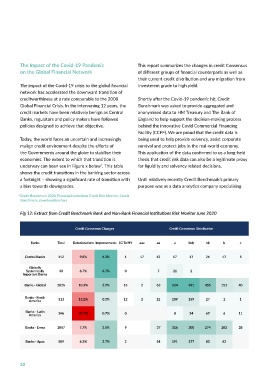
        underway can been see in Figure x below . This table   for liquidity and solvency related decisions.    The Pending Regulatory Framework
                                     1
        shows the credit transitions in the banking sector across
        a fortnight – showing a significant rate of transition with   Until relatively recently Credit Benchmark’s primary   At the end of March 2020, the Basel Committee
        a bias towards downgrades.                purpose was as a data analytics company specialising   announced a delay in the implementation of the
                                                                                                         new Basel Accord enabling banks to focus additional   aggregate output floor, which will require a bank’s
        ¹Credit Benchmark 2020, Financial Institutions Credit Risk Monitor, Credit
        Benchmark, downloadable here                                                                     operational capacity on responding to the impact of   risk weighted assets (RWA), using an internal rating
                                                                                                         Covid-19. Whilst this extra year of planning is to be   approach, to be not lower than 72.5% of RWA as
        Fig 12: Extract from Credit Benchmark Bank and Non-Bank Financial Institutions Risk Monitor June 2020  welcomed, the scale of the challenge for the securities   calculated by the Basel framework’s standardised
                                                                                                         financing industry in preparing to meet this new   approach. Although the Basel accord has drawn up a
                                                                                                         regulatory framework should not be underestimated.   transition process which kicks in at 50%, the increase
                            Credit Consensus Changes          Credit Consensus Distribution
                                                                                                                                                   in RWA allocated for securities financing as a result
                                                                                                         This regulation will not just impact the regulated banking   of these changes is expected to increase by as much
            Banks     Total  Deteriorations Improvements IG To HY  aaa  aa  a  bbb  bb  b  c
                                                                                                         community but also have sweeping ramifications for all   as forty-fold. The new rules in effect limit the ability
                                                                                                         asset owners as well as for the broader capital market.   of banks to apply internal rating models for RWA
          Central Banks  112  9.8%    6.3%    1    17    13    17    17    26    17    5
                                                                                                         Now is the time to begin preparations and identify   purposes. Additionally, the standardised rules state
           Globally                                                                                      potential solutions to mitigate their dramatic impact.  that unrated obligors will attract a 100% risk weight
          Systemically   30   6.7%    6.7%    0          7     21    2
         Important Banks                                                                                                                           allocation. This affects thousands of high-quality but
                                                                                                         One of the rules that most affects the securities   unrated pension and mutual fund counterparties that
          Banks - Global  2026  10.3%  2.9%  16     2    63    624   691  455   151    40                financing industry is the introduction of the   most market practitioners think ought to attract a
                                                                                                                                                   20% risk weight instead.
          Banks - North   311  13.2%  0.3%   12     2    12    109   159   27    1     1                ²By bringing together the internal credit risk views of the world’s leading
           America                                                                                       financial institutions, Credit Benchmark provides an independent and
                                                                                                         unique measure of credit risk. The data contributed by our partners   Credit Benchmark estimates that the savings possible
          Banks - Latin   146  37.7%  0.7%    0                8     54    67    6     11                is subject to rigorous internal ratings systems and/or strict regulatory   by the reduction of the cost of capital from a 100% risk
           America                                                                                       requirements. Credit Benchmark anonymizes and aggregates the
                                                                                                         data before releasing it in the form of Consensus ratings (“CBRs”) and   weight to a 20% risk weight could be up to 2 million
                                                                                                         aggregate analytics. Entity-level credit risk information is available when
          Banks - Emea  1057  7.7%    3.5%    9          37    316   300  274   102    28                                                          USD per notional 1 billion USD of exposure. The basis
                                                                                                         a minimum of three observations are contributed on that particular entity.
                                                                                                         The rule of three applies to ensure the anonymity of those contributing   of this estimation and the underlying assumptions
                                                                                                         credit views to the Credit Benchmark dataset. Basing a Consensus   are outlined below in Figure x - making this issue too
          Banks - Apac  509   6.3%    3.7%    2          14    191   177   85    42                      rating on a minimum of three separate observations prevents reverse
                                                                                                         engineering and enrichens the depth of the data.   expensive to ignore.

        30                                                                                                                                                                               31

