


Page 25 - ISLA_SLReport_Aug2020_double
P. 25
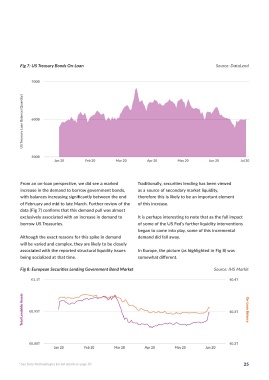
Global Government Bond Markets in Focus  Fig 7: US Treasury Bonds On-Loan    Source: DataLend


            700B

 The first six months of the year have provided an   As we moved into late February, and whilst markets
 almost unique opportunity to observe how financial   had brushed off much of the concerns around
 markets react to external forces, and how factors   COVID-19, the progressive implementation of mass
 other than simple economic fundamentals can   lockdowns in Italy changed the mood; a realisation   600B
 rapidly change sentiment.   that this crisis was now at the heart of Europe,   US Treasury Loan Balance (Quantity)
 and not a contained event in Asia. This previous
 During 2020, we have been able to see the   complacency quickly turned into the so-called ‘dash
 COVID-19 pandemic develop through the lens of   for cash’, as investors sought to secure access to
 our debt and equity markets.   cash and cash equivalent assets. Elsewhere, the
 impacts of the growing pandemic were being felt   500B
 During January and February, we saw a steady rise   in the US Treasury markets, with unexpected yield   Jan 20  Feb 20  Mar 20  Apr 20  May 20  Jun 20  Jul 20
 in both availability as well as the on-loan balances   volatility suggesting structural issues. The week
 of government bonds. Investors appeared to be   of 9 March essentially defined much of what was
 stockpiling high quality low risk assets as a possible   going to happen during the rest of the month and   From an on-loan perspective, we did see a marked   Traditionally, securities lending has been viewed
 reaction to the growing concerns around the   into April. A sudden collapse in oil prices sparked   increase in the demand to borrow government bonds,   as a source of secondary market liquidity,
 spread of the virus, particularly after the World   by falling demand in China ann tensions between   with balances increasing significantly between the end   therefore this is likely to be an important element
 Health Organization declared a global health   leading producers Russia and Saudie Arabia, raised   of February and mid to late March. Further review of the   of this increase.
 emergency on 30 January. This led to a rise in   important questions about the stability of many   data (Fig 7) confirms that this demand pull was almost
 reported government bonds being made available   other emerging economies. This in turn led to central   exclusively associated with an increase in demand to   It is perhaps interesting to note that as the full impact
 for lending by some 15%, from €3 to €3.4 trillion   banks selling US Treasuries to raise dollars to defend   borrow US Treasuries.  of some of the US Fed’s further liquidity interventions
 between 1 January and the end of the two month   their currencies in anticipation of a deepening   began to come into play, some of this incremental
 period. In that early part of the year, on-loan   crisis. Elements of this sell-off can be clearly seen   Although the exact reasons for this spike in demand   demand did fall away.
 balances built steadily as banks sought to rebuild   in the following chart (Fig 6), with some €400   will be varied and complex, they are likely to be closely
 supplies of HQLA assets that had been constrained   billion of government bonds flowing out of lending   associated with the reported structural liquidity issues   In Europe, the picture (as highlighted in Fig 8) was
 over the year-end.  programmes between 9 March and mid-April.  being socialized at that time.   somewhat different.

 Fig 6: Global Securities Lending Government Bond Market   Source: IHS Markit  Fig 8: European Securities Lending Government Bond Market    Source: IHS Markit
 €3.5T  €1.2T  €1.1T                                                               €0.4T


 Total Lendable Assets  €3.2T  €1T  On-Loan Balance  Total Lendable Assets  €0.95T  €0.3T  On-Loan Balance


 Imposition of
 Lockdowns in
 Northern Italy
 24 February  9 March
 €2.9T  €0.8T  €0.80T                                                              €0.2T
 Jan 20  Feb 20  Mar 20  Apr 20  May 20  Jun 20  Jan 20  Feb 20  Mar 20  Apr 20  May 20  Jun 20


 24     * See Data Methodologies for full details on page 50                            25

