


Page 19 - 2516_ISLA_Market_Report_-_Sep_2025_v6
P. 19
18                                                                                                      19

 Securities Lending Market Report | H1 2025


 Equities


 >>>  U.S. Equities

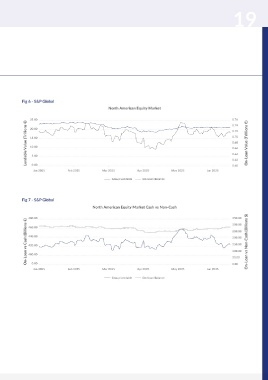
 A very eventful year for U.S. equities securities lending thus far, driven by various macroeconomic factors, geopolitical   Fig 6 - S&P Global
 shifts, regulatory changes and ever evolving market sentiments. To further breakdown, the impact each had on U.S. Equities   North American Equity Market
 are following:
 •   Geopolitical conflicts and trade disputes introduce   Overall, U.S. equities contributed to $650mn in revenues   25.00  0.76
 uncertainty and fear into the global economic environment,   with average fees reaching multi-month high of ~1.2% after   0.74
 leading to increased stock market volatility. Investors react   Coreweave Inv (CRWV) record a monthly VWAF of 1755 bps.   20.00  0.72
 to perceived risks, potentially causing sharp price swings in   Balances surged to an average for $655.8bn (highest level   15.00  0.70
 equity markets.  seen for many months).   Lendable Value (Trillions €)                                 0.68   On-Loan Value (Trillions €)
 •  Global trade uncertainty and geopolitical conflicts can   U.S. equity market was driven by outperforming corporate   10.00  0.66
 disrupt global supply chains, leading to challenges such   earnings, especially the Mag 7 which gained momentum after a   5.00  0.64
 as transportation delays, higher freight costs, and even   sluggish start at the beginning of the year, due to involvement   0.62
 shortages of crucial materials. These disruptions can extend   in AI.   0.00                           0.60
 production timelines, increase labor costs, and negatively   While small cap continued to underperform with Russell 2000   Jan 2025  Feb 2025  Mar 2025  Apr 2025  May 2025  Jun 2025
 impact corporate earnings across various industries,   down 7.3% through June, small cap tech firms specially those
 ultimately influencing stock prices.              Group Lendable  On-Loan Balance
 involved in Quantum Computing saw good returns as they
 •  Increased costs from tariffs and supply chain disruptions   trade specials (deeper fee) due to skepticism (RKT, QUBT, etc),
 can fuel inflation. High inflation, particularly if it‘s surging,   also reflecting investor concerns about higher interest rates
 can put pressure on corporate profit margins and increase   with greater financing needs.   Fig 7 - S&P Global
 market volatility, as companies grapple with raising prices or   ADRs maintained their strong revenue performance, increasing   North American Equity Market Cash vs Non-Cash
 absorbing higher costs
 131% YoY making June the second-best revenue month of the
 •   Imposing tariffs, particularly on key imported goods like   year at $47mn.                         350.00
 clean energy technologies, can lead to increased costs for   Through the months with increased balances, actively   300.00
 U.S. companies. For example, U.S. manufacturers relying   managed exchange-traded funds (ETFs) continue to   460.00  250.00
 on foreign components for solar panels, wind turbines, and   experience remarkable growth, due to combined benefits   440.00
 batteries face higher import costs, impacting their profit   of professional management with the structural advantages,   On-Loan vs Cash (Billions €) 480.00  200.00 On-Loan vs Non-Cash (Billions $)
 margins.     420.00                                                                                    150.00
 which include greater tax efficiency, lower expense ratios
 •   The clean energy sector, reliant on global supply chains   compared to mutual funds, intraday liquidity, and improved   400.00  100.00
 for components, is particularly vulnerable to the impact   transparency.                               50.00
 of tariffs and trade tensions. Rising costs and policy   0.00                                          0.00
 uncertainty can hinder new investments in renewable   Jan 2025  Feb 2025  Mar 2025  Apr 2025  May 2025  Jun 2025
 energy and related technologies, potentially impacting   Group Lendable  On-Loan Balance
 the country‘s energy transition goals. For instance,
 despite growth in domestic manufacturing, the U.S. still
 heavily relies on imported solar panels, and increased
 tariffs disproportionately affect imports from key supplier
 countries.

