


Page 29 - 2516_21_June_ISLA_Market_Report_-_June_2021_-_final
P. 29
28                                                                                                      29

 Securities Lending Market Report | June 2021


 Collateral Dynamics


 As our markets have grown and evolved the role of collateral has also changed. From simply being a risk mitigant   Fig 15 - DataLend
 against loss in the event of a counterpart default its form and composition can now, in many cases, define the
 economics of a trade. Prior to the 2007/08 crisis we saw how expansive cash collateral reinvestment programmes
 could be used to drive overall performance. Looking back with the benefit of hindsight it is unlikely that   Global Collateral On-Loan (Cash vs Non-Cash)
 programmes structured in this way would be seen as desirable by today‘s risk averse standards. Today, a different
 set of fundamentals and drivers  increasingly determine the way we think about collateral.   1,600       850
 As other markets and products demand greater and more astute use of collateral, we may see an increasing desire   1,550
 to try and optimize the use of collateral on a cross product basis, although the operational and legal challenges of   800
 doing this should not be underestimated. The investment in infrastructure, systems and legal support needed could   1,500  750
 be prohibitive especially if desired outcomes around areas such as capital usage are not certain.   Non-Cash CollateralOn-Loan (Billions €)  1,450  Cash Collateral On-Loan (Billions €)
 We have been tracking the development of collateral usage as part of our Securities Lending Market Reports for   1,400  700
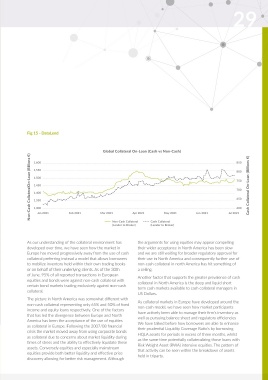
 several years and as at the 30th June we saw some 66% of all loans collateralized with other securities (non-cash)   1,350  650
 and 34% being collateralized with cash collateral.  1,300                                                600
                                                                          May 2021
                  Jan 2021
                                                            Apr 2021
                                Feb 2021
                                              Mar 2021
                                                   Non-Cash Collateral  Cash Collateral  Jun 2021     Jul 2021
                                                   (Lender to Broker)  (Lender to Broker)
             As our understanding of the collateral environment has   the arguments for using equities may appear compelling
             developed over time, we have seen how the market in   their wider acceptance in North America has been slow
             Europe has moved progressively away from the use of cash   and we are still waiting for broader regulatory approval for
             collateral preferring instead a model that allows borrowers   their use in North America and consequently further use of
             to mobilize inventory held within their own trading books   non-cash collateral in north America has hit something of
             or on behalf of their underlying clients. As of the 30th   a ceiling.
             of June, 95% of all reported transactions in European   Another factor that supports the greater prevalence of cash
             equities and bonds were against non-cash collateral with   collateral in North America is the deep and liquid short
             certain bond markets trading exclusively against non-cash   term cash markets available to cash collateral managers in
             collateral.
                                                              US Dollars.
             The picture in North America was somewhat different with   As collateral markets in Europe have developed around the
             non-cash collateral representing only 65% and 50% of fixed   non-cash model, we have seen how market participants
             income and equity loans respectively. One of the factors   have actively been able to manage their firm‘s inventory as
             that has led the divergence between Europe and North   well as pursuing balance sheet and regulatory efficiencies
             America has been the acceptance of the use of equities   We have talked before how borrowers are able to enhance
             as collateral in Europe. Following the 2007/08 financial   their prudential Liquidity Coverage Ratio’s by borrowing
             crisis the market moved away from using corporate bonds   HQLA assets for periods in excess of three months, whilst
             as collateral due to concerns about market liquidity during   as the same time potentially collateralizing those loans with
             times of stress and the ability to effectively liquidate these   Risk Weight Asset (RWA) intensive equities. The pattern of
             assets. Conversely equities and especially mainstream   that activity can be seen within the breakdown of assets
             equities provide both better liquidity and effective price   held in triparty.
             discovery allowing for better risk management. Although

