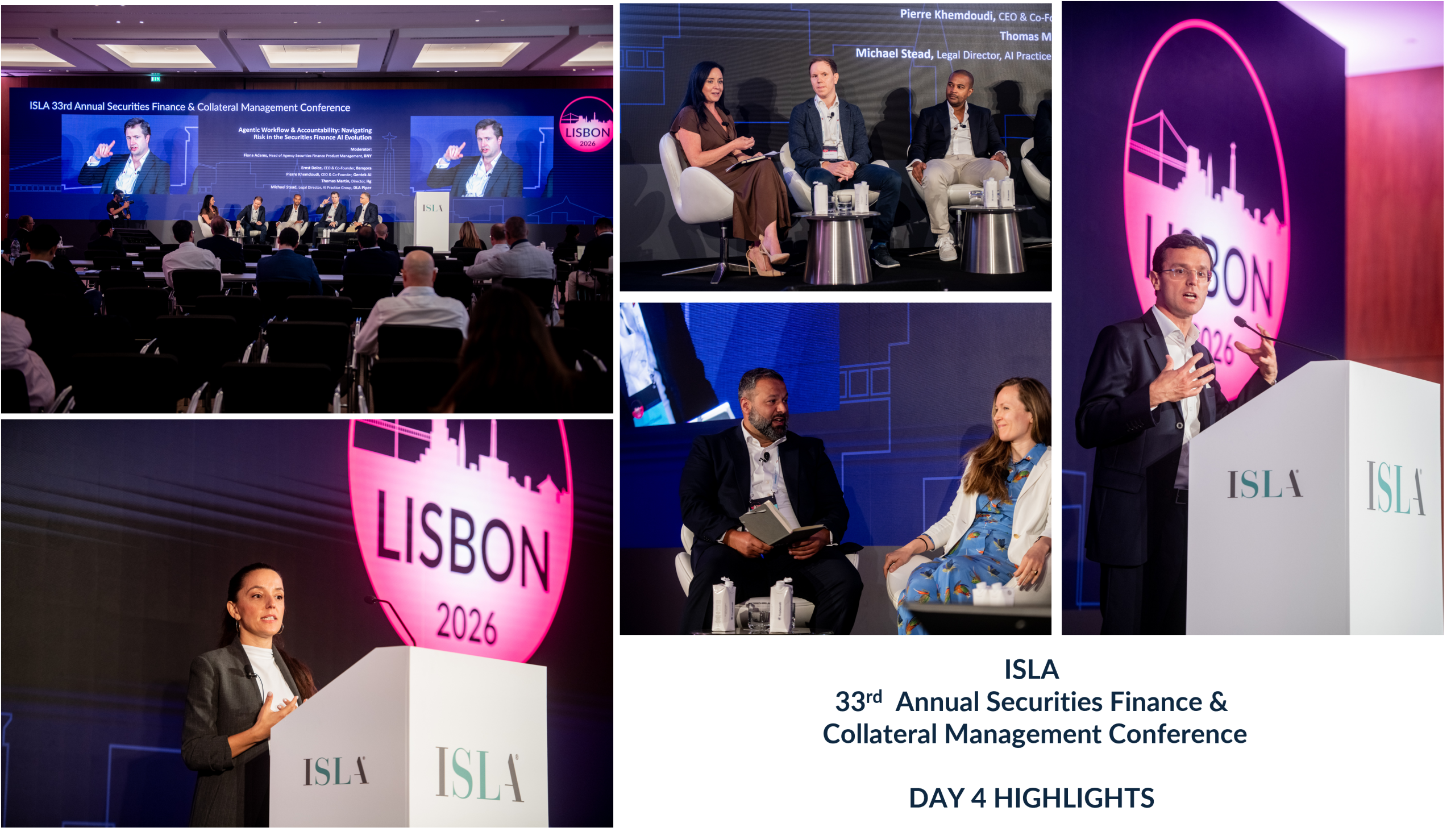
The fourth and final day of the 33rd Annual Securities Finance & Collateral Management Conference was kicked off by our co-chair, Keren Halperin, with a recap of Wednesday’s highlights, from AI to digital advancements and the fact that we have seen abundant growth across our entire industry.
New Players, Different Game?
ISLA’s Stephen O’Donnell headed our first panel which set about unpacking the driving forces behind this new supply:
- Retail is Becoming a Structural Source of Liquidity: What started as niche or “alternative” supply is now increasingly part of the mainstream securities finance mix, especially in ETFs, hard-to-borrow names, and smaller-cap liquidity pools.
- Access, Consent & Disclosure Are the Real Bottlenecks: The operational challenge is not demand, but converting millions of retail accounts into lendable supply while managing consent, segregation, investor protection, and fair value sharing across fragmented European rules.
- Technology is What Scales the Model: APIs, automation, and better allocation logic are needed to handle account-level complexity, improve recall management, and keep retail lenders and borrowers aligned on timing, economics, and transparency.
- Retail is Here to Stay, But Still Maturing: Retail securities lending is now a lasting part of market structure, yet broader adoption depends on stronger standardisation, regulatory clarity, and trust in operational resilience.

Unlocking Liquidity: The Evolving Landscape of Securities Finance in MENAT & LATAM
Building on new supply, we next explored the infrastructural, regulatory and technological frameworks shaping emerging and frontier markets:
- Liquidity is Still Being Built Market by Market: MENA and LatAm are moving from frontier to scalable securities finance markets, but supply is still concentrated in a handful of names and the real unlock is broadening access into mid-caps, smaller names, and local-holder inventory.
- Operational Friction is Now the Main Constraint: The biggest blockers are onboarding, documentation, tax, lifecycle events, collateral control, and settlement mechanics — especially where local market structure still relies on centralised or manual processes.
- Regulation & Market Structure Need to Catch Up: T+1, netting, close-out rules, Sharia structures, and collateral enforceability all need clearer treatment, and that the education of regulators, lenders, and beneficial owners is essential to unlock scale.
- Technology & Standardisation will Decide the Pace: Automation, better infrastructure, and more standardised processing is the practical route to scaling across Saudi Arabia, Brazil, the GCC, and other growth markets, with the strongest future model being one that can handle T+1-style lifecycle events end to end.

Agentic Workflow & Accountability: Navigating Opportunity & Risk in the Securities Finance AI Evolution
Closing out our final sessions was an exploration into the operational realities as well as the practical challenges of deploying AI responsibly and at scale:
- AI Moves into the Workflow: AI is no longer just a tool on the side; it is being embedded directly into workflows to shape decisions, trigger actions, and improve prediction. That shift raises the opportunity to automate more of the market’s “plumbing,” but it also brings into focus accountability, control, and resilience.
- Innovation Needs Guardrails: While AI can accelerate productivity and unlock new products, financial services cannot afford the same trial-and-error approach seen in less regulated sectors. The industry needs systems that work from day one, with clear governance, human oversight where needed, and strong design around failure modes.
- The Human Role Changes, Not Disappears: AI should be used to augment teams, not simply replace them, with people moving toward higher-value judgement, validation, and decision support. The discussion pushed back on vague “human in the loop” language and argued for clearer responsibility, stronger operational design, and a more intentional division of work between people and systems.
- Adoption Will Be Uneven, but Fast: The panel stressed that firms will move at different speeds, depending on regulation, risk appetite, and enterprise readiness, but the direction of travel is clear. Cost, speed, and model choice all matter, yet firms that build narrow use cases first, and invest in culture and education will be best placed to capture the upside.

To close off the event, ISLA Chair, Alessandro Cozzani shared his key takeaways, as well as some ISLA highlights to look forward to.
Alessandro explained that with solution providers now aligned with all aspects of securities finance, the need for collaboration across the ecosystem is essential. This integration was reflected by the over 50 sponsors of this year’s conference.
As the market expands, success depends on scaling with regional nuance, balancing global connectivity with the flexibility to navigate local regulatory and trading demands, and as markets evolve, so too does ISLA. With a global outlook and strong collaboration with peer associations, our role is to ensure the legal, regulatory and operational foundations are in place to support our members growth and help drive commercial opportunity.
Thank you to all of our Thursday speakers and panellists:
Welcome Remarks & Recap: Speaker: Keren Halperin (Sharegain)
New Players, Different Game? Moderator: Stephen O’Donnell (ISLA) Speakers: Johanne Armita Vara (Goldman Sachs), Thomas Hoang (Citi), Alex Panaite Fornari (Sharegain), and Sharon Terry (L&G Asset Management)
Unlocking Liquidity: The Evolving Landscape of Securities Finance in MENAT & LATAM: Moderator: Cassie Von Sprecher (Deutsche Bank) Speakers: Adam Chaput (Morgan Stanley), Curtis Dutton (HSBC), Jalal Faruki (SNB Capital), and Patrick Morrissey (The Vanguard Group)
Agentic Workflow & Accountability: Navigating Opportunity & Risk in the Securities Finance AI Evolution: Moderator: Fiona Adams (BNY) Speakers: Ernst Dolce (Banqora), Pierre Khemdoudi (Gentek AI), Thomas Martin (Hg), and Michael Stead (DLA Piper)
Closing Remarks: Speaker: Alessandro Cozzani (Bank of America)